- Unpoetic Limericks
- Posts
- The Art of Community
The Art of Community
Vedurnan at Biennale Jogja 18, Art vs./and Craft, Biwako Biennale, on 'Generosity'

Kelly Jin Mei
October 24, 2025

CALENDAR UPDATES
EXHIBITIONS
Biennale Jogja 18: KAWRUH: Land of Rooted Practices
Biennale in Yogyakarta (Indonesia)
5 Oct - 20 Nov 2025
18th International Triennial of Textile Łodz 2025: Deconstruction/Reconstruction
Triennale at Central Museum of Textiles (Łodz, Poland)
11 Oct 2025 - 12 Apr 2026
It’s been a while— a very conscious break, actually! Most of the time, when this newsletter lapses, I’m in the background mentally kicking myself knowing that I’m behind yet again. Since my last newsletter in July, I had been working on my new artwork, Vedurnan, which is currently being exhibited in Jogja Biennale. After about 6 weeks of extremely hard work (12 hour work days where I would look up with crossed eyes, not knowing the time or where I was— it would take me seconds to realise I’m still in Singapore), I decided I would give this newsletter a little break.
I wanted to push my writing muscle by writing regularly, yet this break has been helpful for me to re-centre some thoughts, catch up on much-needed reading, and just simply rest. The only downside is that I have a huge backlog of things I want to talk about.
WHAT I HAVE BEEN UP TO
Vedurnan at Jogja Biennale 18

Installation view of Vedurnan at Jogja Biennale 18
It’s been a rare, happening year for me; Vedurnan is exhibiting at the 18th Jogja Biennale, while the prequel to this, Anekanta, is exhibiting in Poland for the 18th International Triennial of Textile. I’m glad these sister pieces are across the world from each other now, sharing their stories to 2 completely different audiences.
I shared some behind-the-scenes of the making of this work on Art&Market’s website, which you can read over here. I’ve been pondering upon how one might learn about the stories behind works like Vedurnan and Anekanta without having to read a wall of text resulting from long days of research— but until I figure out how, you may read my write-up on my website.
Unhurried Couch Talk: Art vs./and Craft
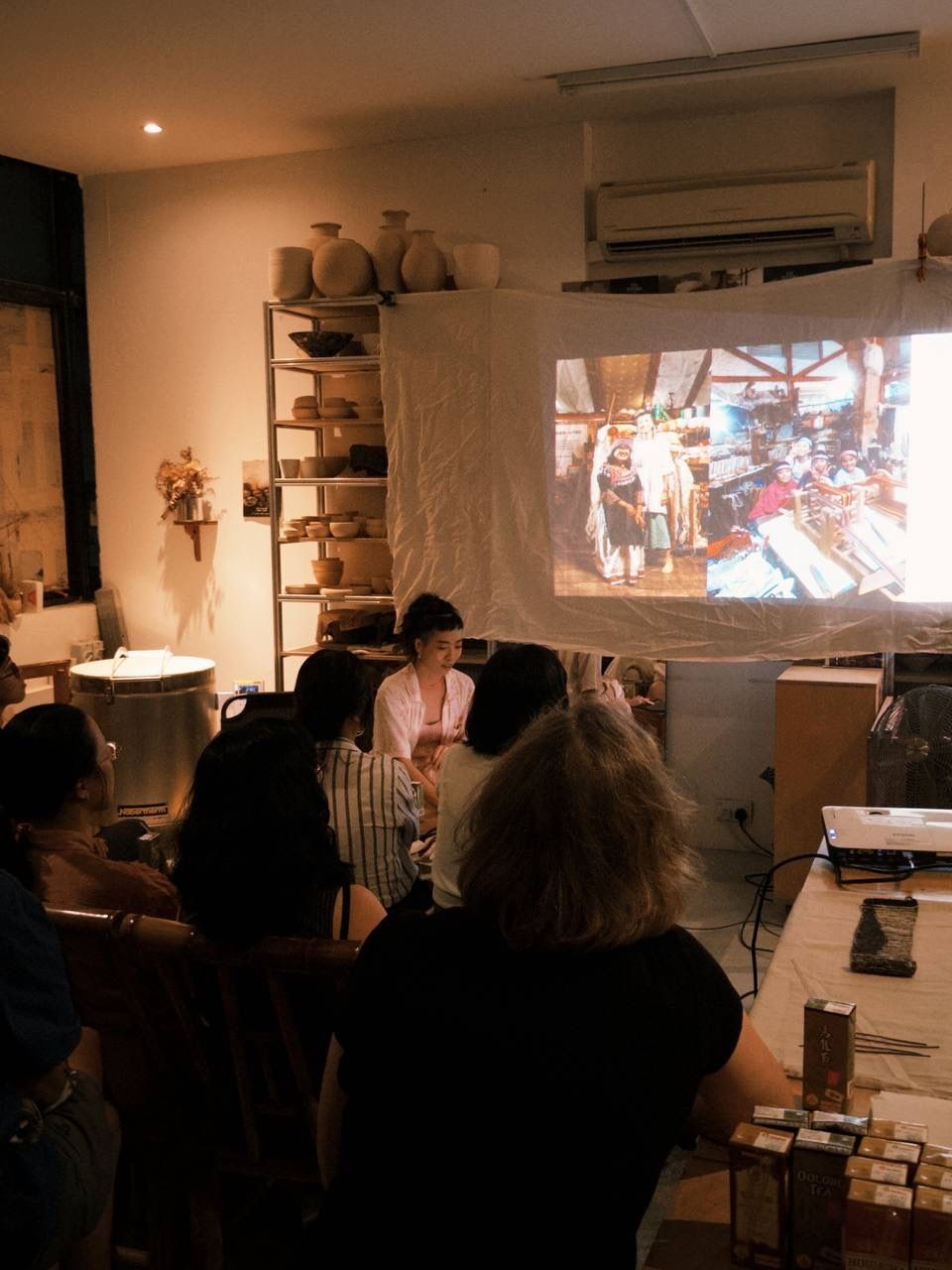
Unhurried Couch Session at Un Studio
The good people at Un Studio, a ceramics x woodworking unit invited me to give a talk at their Unhurried Couch sessions in August. I am usually asked to share about my ‘journey’— and I’ve talked about it to a point it feels flat, unauthentic (like the repeated memory has taken over the actual one), and self-congratulatory. So I was excited when they brought up 2 themes I actually DO want to talk about— Residencies, and the boundaries of Art and Craft.
It gave me so much to think about that I expanded it into a short article on my website— which sparked even more questions. The great thing about writing something down is you have a record of your thoughts at that point of time, incorrect or not, so you can at least mark a growth or change in mindset. It also makes a good starting point for interesting conversations. I’m dreaming of creating a small zine, where I invite artists, artisans, or anyone who has an interesting perspective to write short essays about Art and Craft, their relationship and supposed boundaries. I’ve always imagined making a zine which is a sum of conversations; a growing ‘diary’ if you will. If you have something to share, do contact me; let’s start something together!
NEW THINGS I SAW
Jogja Biennale 18: KAWRUH, Land of Rooted Practices
It was my fourth time in Yogyakarta this time, and I feel like ok, I’m actually starting to fall in love with the place. Even though Indonesia is such a close neighbour to Singapore, you get a bit of a culture shock the first time. The mosquitoes and relentless humidity are things I’ll never learn to love— but I will put up with them for the amazing community, the art scene, the craft I admire in Jogja.

The theme this year, Kawruh, is a Javanese word that can be interpreted as a “means knowledge as an accumulation of experience that is critically digested by reason”. This knowledge encompasses that gained through bodily practices and awareness rooted in local wisdom, bringing in mythology, history and agricultural practices, just to name a few. Headed by 3 curators, ketjilbergerak (Indonesia), Bob Edrian (Indonesia) and Ihwa Eva Lin (Taiwan), this edition sees a mix of international artists spread across 11 locations.
Being a city with such strong community spirit, it is no surprise that the Biennale involves the villagers as participants and makes use of communal locations used for local dance practices or gathering points. I find that the mark of a successful art festival is when the work doesn’t feel ‘imported’ into the space, and that the people who constantly access the venue engages with it, even without needing to read a write-up. Site-specificity has become such a catchword recently, but making it work is not as simple as it seems. I subscribe to the notion that art should serve the community, not the other way round, so it is always heartwarming to see how art transforms— whether through the artist and locals exchanging knowledge, unused spaces being activated and enlivened or allowing locals to see the world through a different perspective.

Artwork by NIWA Yuta
One of my favourite venues in the Biennale is Toko Purnama, nicknamed “Full Moon Art Space”. Shell of a soon-to-be hypermarket, the raw concrete structure is turned into a temporary site for art, with windows overlooking the surrounding wildness.
This artwork by Japanese artist NIWA Yuta above presents a seemingly innocent and almost comical banquet. Painted on local treebark paper, it pulls in motifs familiar to Indonesians; yet it conceals darker imagery of the Japanese Occupation of Southeast Asia during their attempt to establish the Greater East Asia Co-Prosperity Sphere. Sunlight hits the painting from the back, bringing the fibres of the paper into relief. Yuta shared with us how he would normally patch whatever smaller pieces of paper are available together while out sketching en plein air; this naturally led to him piecing the treebark paper this way as well, though stitching with thread instead of tape. To produce the best effect of ink, he also had to consider the different thickness of paper due to its handmade nature.
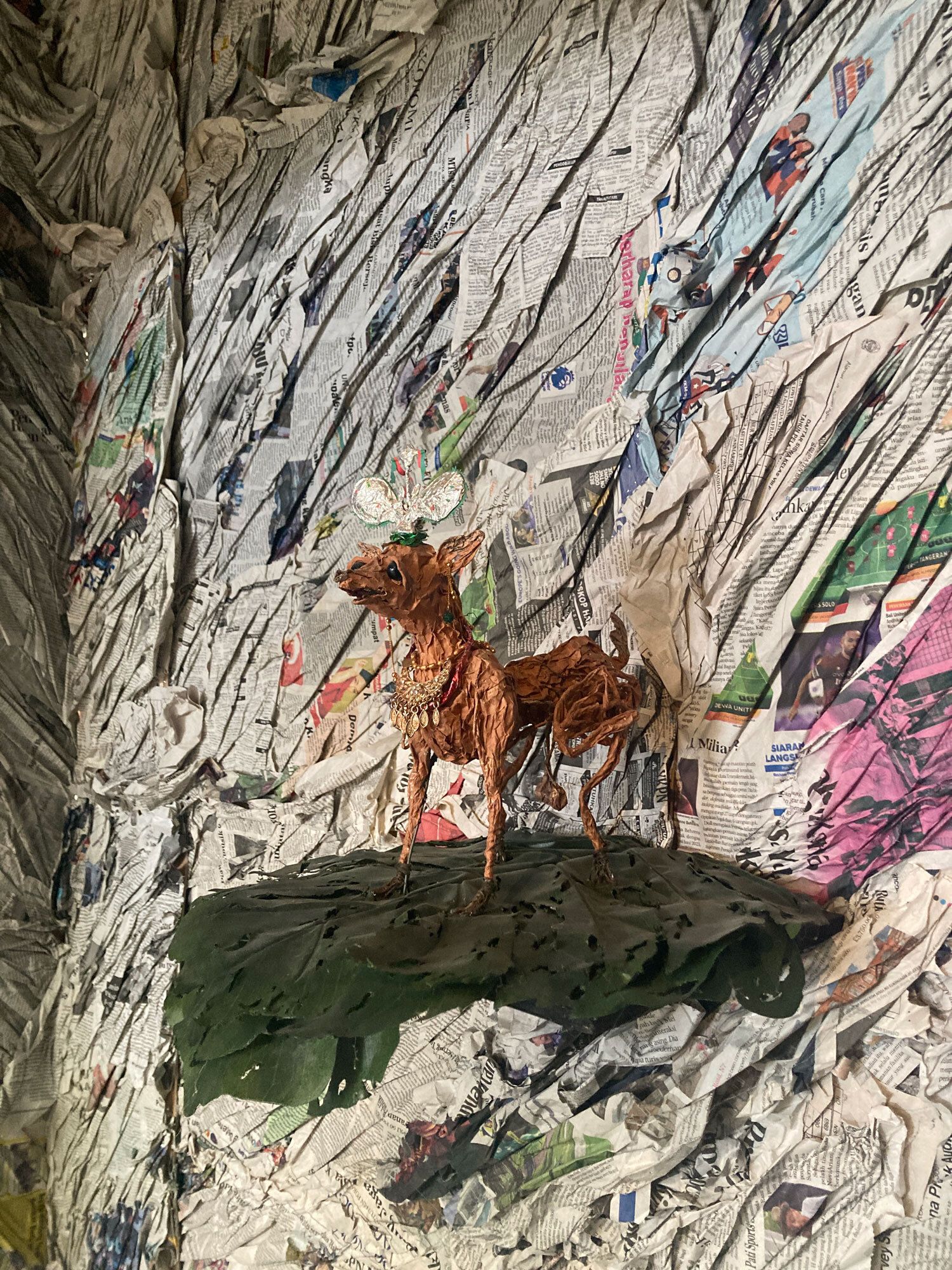
Paper puppet by ZHANG Xu Zhan
Within the same space, a stop-motion film by Taiwanese artist ZHANG Xu Zhan runs in an area fully plastered with crushed newspaper. Coming from a family with a tradition in paper puppet making, Xu Zhan created this puppet of the Kanchil (Mousedeer) during his residency in Yogyakarta, then spent about 5 years to put together the film with his team. Compound Eyes of Tropical shows the various dramatic interpretations of the local folklore of the Mousedeer crossing the river through the lens of a housefly.
For one of the opening events, the puppets were moved to a local gathering area out in the fields, where there was a film screening with a live band, performing on local instruments like the Gamelan. Locals and people from the art industry alike attended, and it was touching to see how art needed no words.

Zombie Bakso by Ayaka and Shooshie Sulaiman
On that same night, we had the most delicious Bakso (meatball noodles) as well— Artist Shooshie SULAIMAN decided to trade roles with her assistant, Ayaka YOSHIDA for this collaboration. Ayaka spent about 1 month studying Bakso, which resulted in this pushcart going to a different location everyday. In a bid to study Bahasa Indonesia, which she thinks is a beautiful language, Ayaka gives a discount to locals if you share a ‘beautiful’ local phrase with her. It’s not just a performance made for the Biennale; the artists bring the cart deep into the village (where even we could not locate them), selling the noodles to schoolchildren and ibuibu (local aunties) alike.
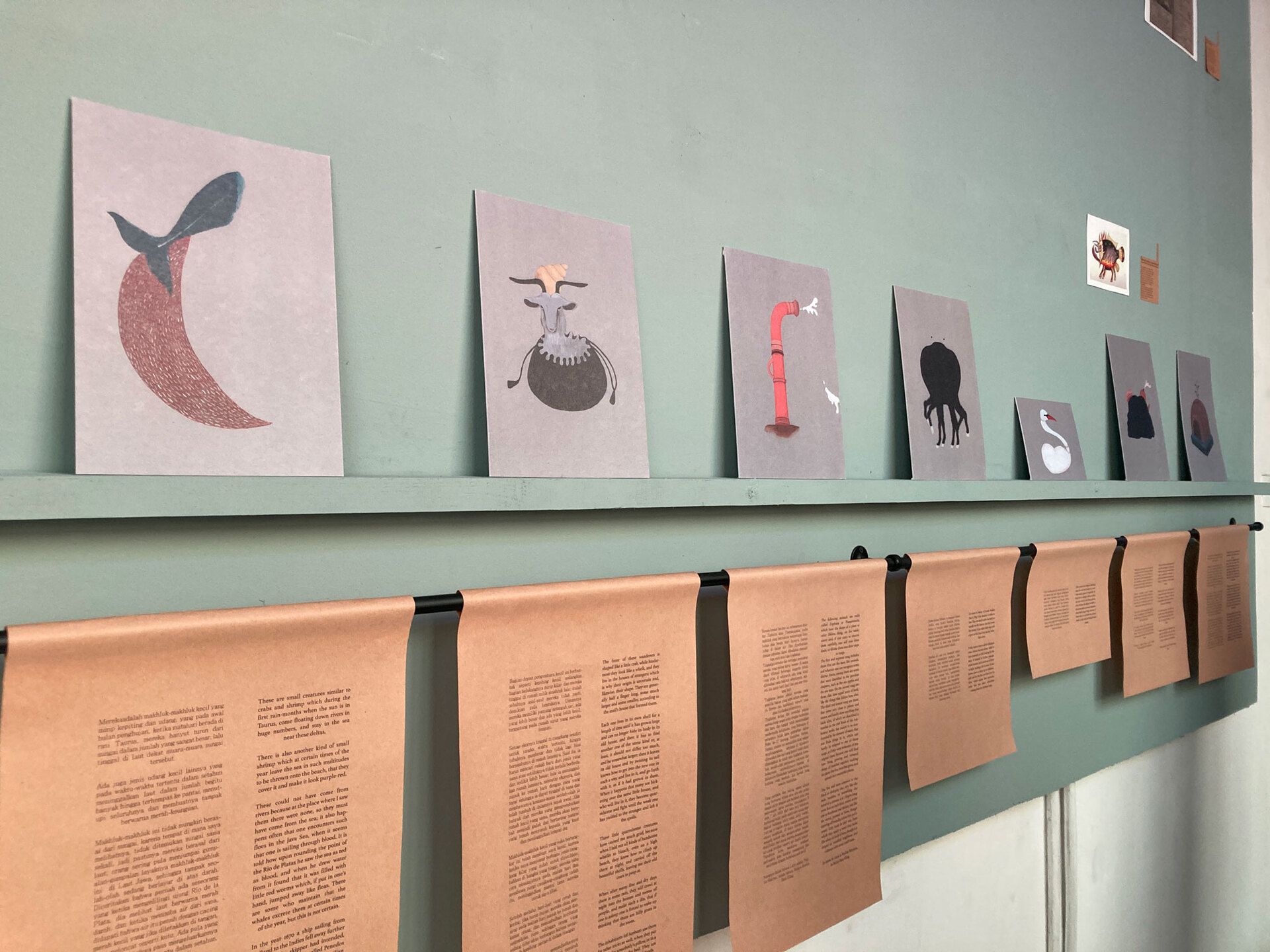
Artwork by LIU Yu
Taiwanese artist LIU Yu visited Ambon Island and stayed with the local community for about a month, researching the local spices, food, and way of life. Her research focuses on the botanist Georg Eberhard Rumphius, who published a catalogue of plants from the island in spite of his blindness. Some of the accounts of the plants were gained from oral accounts from the locals and using his other senses like touch. She produced a series of ‘fantastical’ illustrations based on her studies and interviews with the locals.
There are truly too many interesting works to talk about, and I am extremely humbled to be among such experienced artists and given the chance to speak with them and learn about their practice. Many times, I felt like the smallest fry in the room being inspired by all the bigger fish around me, which is a good thing. I won’t lie; there were times it felt lonely being the only Singaporean present. Both Taiwan and Japan had members of media, sponsorship foundations, and so on present. But, I am also proud of myself for making it to where I am, independently (though I am grateful to that few people who have believed in me). I used to hope that, as a sapling, someone would put a stick beside me so I’d have a way to grow bigger. Now, as I get older, I realise that I was going to grow anyway, support or not. It is strange how after I’ve grown my own way, that people would start to stick sticks into the ground around me when they no longer serve any purpose. This analogy also helps me realise having supporting crutches early might make one tall and strong; but all those trees look the same.
I’m not going to lie; I was a bit disappointed with this one. Autumn is always a busy period for art festivals in Japan, and since I missed the previous one, I was very much looking forward to this. The reason I did not enjoy the Biennale as much was not due to the quality of the artwork though; I think such festivals are where curation and more importantly, relationships with the venue and community are crucial in creating a good experience.
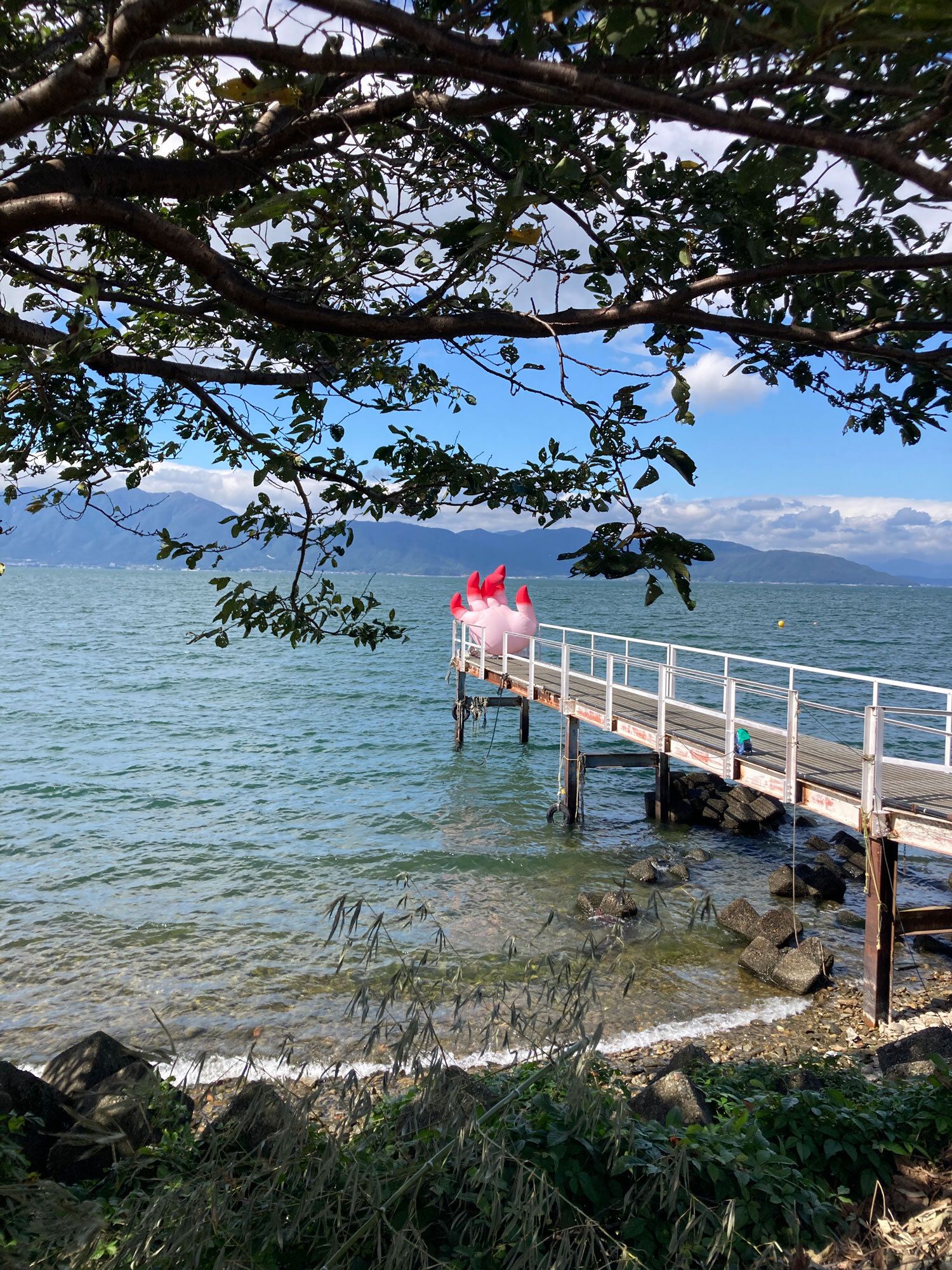
Artwork by Zhou Yiqiao, on Okishima island
The Biennale, which theme this year is FLUX, is spread across 3 main areas: Ōmihachiman town, Okishima island, and Chōmeiji Temple. The first thing I observed was how little I actually saw of Biwako lake, even though it is called the Biwako Biennale. Most of the works were centred in the town area, which made it convenient, but aside from the obvious references to water or spiritual links to the lake (if any), the venues and work did not highlight the region very well. Some of the artworks were amazing in their craft, but seemed a bit out of place.
I was excited to visit the island venue, which had 5 artworks; however, it was quite clear to me that the inhabitants of the island were not too excited to be part of the Biennale. Most of the works were outdoors, and instead of looking majestic or enhancing the beauty of its surrounding environment, looked rather forlorn. The only indoors location was in complete disarray and unlit. The few of us visiting exchanged confused looks and poked around in the warehouse to be sure the real artwork wasn’t hiding elsewhere; about 30 minutes before the ferry arrived, we were seated around the pier, all ready to leave. 3 of the 5 artworks on the island were inflatables; I will say, I won’t be sorry when I see inflatables fall out of the art festival trend in a couple of years. (I don’t hate all inflatables; there’s just an occasion for everything.)

Artwork by TANAKA Masato
I did however, observe that quite a number of artworks used technology pretty well, such as the one above by TANAKA Masato (田中誠人). I’ll start with a related story— I used to frequent this prata restaurant which had a LED running marquee of all their available prata flavours. If you stared at the marquee long enough, there is a particular part where it jams for a second, and it feels like time stops. I would always stare at it to chase that very bizarre feeling.
This artwork speaks of the ‘unnatural’ phenomenon of photo-taking, even though we have become so used to it today. The artists imagines how strange it must be for the first humans to see time ‘stop’ in a frame. The clocks around the room are all furiously ticking at their own pace— pendulums swinging, hands racing; and visitors are invited to ‘take a photo’ by pressing a remote shutter connected to the camera. Once the camera shutter closes, the clocks simultaneously stop, and the room falls eerily silent until you release the shutter again. Aside from the visual spectacle and experience, the work perfectly conveys the ‘unnatural’ phenomenon we take for granted today.

EGASHIRA Makoto
I have been a fan of EGASHIRA Makoto for years, and am glad that seeing the real work still intrigues me. (It might be a job hazard, but sometimes figuring out how an artist does their work spoils the charm of it a bit!) His work is straightforward: he wraps things up (and I mean, everything) in those old-school, furry blankets with rose prints on them. The resulting room resembles an otherworldly set that evokes nostalgia, but also questions the boundary between ‘Japanese-style’ and ‘Western-style’ we often see in Japan— be it food, toilets, or even facial features.

A spider made of uranium glass beads, settled in a warehouse. By Ken + Julia Yonetani
While every festival has their own agenda and style, I feel an increasing admiration towards those which consider the environment and accessibility of the pieces to the audiences. I will be visiting Rokko Meets Art and Aichi Triennale in the coming month, and am looking forward to it!
LAST THOUGHTS
Generosity
For the past few years, I have been actively rejecting most commission jobs to focus on my studio work. However, I started considering alternative modes of working, in order to balance my personal explorations and ‘bread-and-butter’ jobs. Contrary to popular belief (in Singapore), it is entirely possible to maintain artistic integrity while considering a client’s needs. As someone from a design background, I actually enjoy that challenge. It also opens up opportunities to collaborate with other artisans/artists, or tinker with new mediums.
Recently, I received a commission enquiry that honestly seems quite fun. Oftentimes, when I get these offers, or when I engage crocheters for my projects, I think how much I would enjoy them if I had been given such opportunities in my youth. I remember wishing crochet could be my part-time job while I was in school. I sometimes base my crocheters’ salaries on what I think I’d be happy to get. It took some time for me to realise using myself as a benchmark is not a great idea.
Unfortunately, the aesthetic of this job was too different from my artist portfolio. I felt like letting go of it entirely would be a waste; usually, when I reject the job, the clients turn to a completely different medium. But I DO want to see crochet out in the wild! I want crochet to be a medium you could consider for things like commercial campaigns or photoshoot sets. I imagine crochet being seen as a skill, and a viable source of income. Knowing crochet is trendy now, I started seeking out crocheters who could take up the job. However, while there are many crocheters around, most do not have installation experience, and seem to stick with the ‘sellable’ things. I approached some crocheters I worked with previously, but they were not confident.
“We want to, but how do we start? What can we do to become more confident?”
The questions stunned me a little, because, how indeed did I start? I just dived into it and gained experience. That’s all. I realised there is a gap in the market, and yet another new idea bubbled up— maybe it’s time for me to start a collective I could train to handle commercial commissions! I got all excited with the idea, and decided to run it by a close (Singaporean) friend.
“I’m sorry to disappoint you Kelly, but I think it’s not going to work. Singaporeans are prideful. They are going to think, “Who the hell does this Kelly think she is? Why do we have to be trained by her?”
Honestly, it stung a bit. I must’ve been still riding the community high I got from being in Yogyakarta. There, I was speaking with a crochet-based artist friend I most respect, and he said: Textile art is already being marginalised. There are so few of us. We can’t fight! We need to band together, and grow bigger, and only then can we all get better together.
But my Singaporean friend’s comment brought me back to reality. She was, sadly, right. The past few times I had similar ideas of ‘building’ something bigger— I always ended up being the bad guy, or being stabbed in the back. People always thought I had a personal agenda. A friend used to say: There is no such thing as a selfless good deed. Because when you do something good, you FEEL good. You do it because you feel good being a ‘good’ person.
Is that so wrong though? Monks beg not because they are poor— it teaches them humility, but it also gives US a chance to be generous. It feels great to be generous. You might judge me, but I feel happy outside Singapore because I can finally GIVE. In Singapore, you always feel like you never have enough. You can’t help but think of yourself first. In Yogyakarta, my friends have so much less than a regular Singaporean— but that doesn’t stop them from giving. It feels like because there is not so much to go around, we shall all share it. And they never expect anything back. Ironic, really, how excess makes us stingy. You might say it’s simply a ‘mindset thing’, but societal pressure does weird things.
I really enjoy starting something new. Building something. Collectives! Collaborations! I often WISH for things, and that wish motivates me to do something for someone else. For example, I always wished that someone would produce my exhibition for me. I deal with it by learning how to and producing my friend’s exhibition. I wanted an art circle that did not discriminate against craft-based practices and people with no art school experience; so I co-founded the School of Common Understanding, a skill-sharing collective (that was killed by COVID). It’s tiring to sustain it though, when people don’t reciprocate and even suspect your motives. When you have no money, all you can give is time and faith. For such things to work, you need to think about giving more than taking, and I wonder when we will be ready as a community.
Reply